

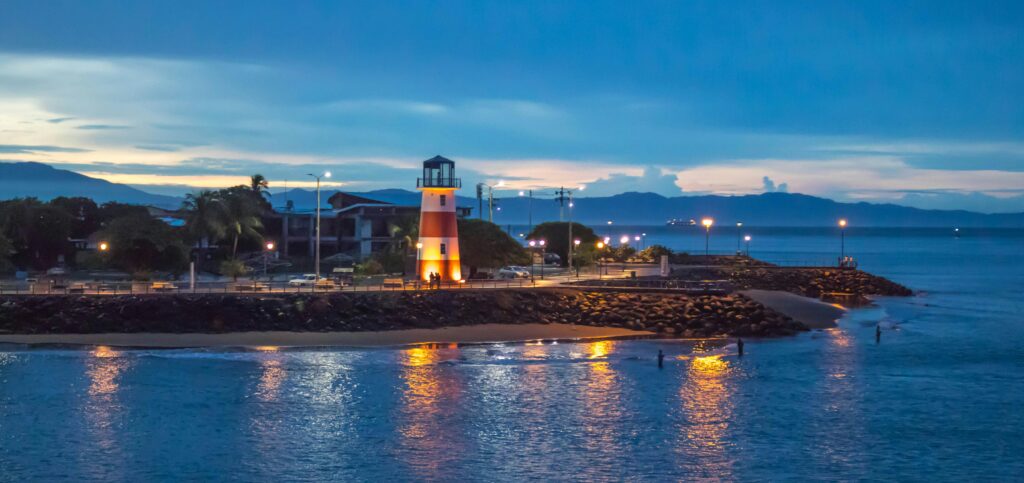
The city of Puntarenas, set upon a sand spit that whimsically stretches into the Gulf of Nicoya, stands as a historical and social laboratory of Costa Rican identity. At the heart of this narrow strip of land, the Paseo de los Turistas emerges not merely as a roadway or recreational space, but as a material chronicler of the country’s economic transformations—from the coffee boom of the 19th century to the consolidation of today’s cruise industry. Walking its three kilometers is a journey through time, where neoclassical architecture, identity-rich gastronomy, and the resilience of a people who have learned to live facing the sea converge.
Table of Contents
Genesis of a port and the awakening of tourism
Puntarenas exists as the result of a dynamic sedimentary process driven by the Barranca River, which over centuries shaped what was originally known in 1722 as the “Puerto de Arenas.” Its administrative importance was formalized on April 29, 1814, when the priest Florencio del Castillo petitioned the Cortes of Cádiz to declare it a Major Port for the commerce of the Province of Costa Rica. This designation became the catalyst that allowed the country to export the “golden grain,” coffee, to markets in Chile and Great Britain, consolidating the city as the main gateway to the Pacific.
As trade expanded, so did the urban landscape. The Paseo de los Turistas, originally known as Paseo León Cortés in honor of the president who governed between 1936 and 1940, was conceived with the vision of integrating the scenic beauty of the coastline with the functionality of a modern avenue. However, it was not until the 1940s that Puntarenas was declared the “National Seaside Resort,” becoming the preferred destination for families from the Central Valley seeking refuge in its warm waters and cinematic sunsets. This golden era of local tourism left an indelible mark on generations of Costa Ricans, who still regard “El Puerto” as their essential getaway.
Architectural heritage: A dialogue between past and present
The Paseo and its surrounding streets house architectural treasures that narrate the city’s evolution. One of the most imposing landmarks is the Puntarenas Cathedral, dedicated to the Sacred Heart of Jesus and built in 1902. This temple is unique in the country due to its orientation: while most Catholic churches face west, its main façade looks eastward, toward the town. Constructed with stone and mortar from quarries in Esparza and Cartago, its neo-Gothic exterior contrasts with a neoclassical interior that offers a peaceful refuge from the port’s commercial dynamism.
Another cornerstone is the House of Culture, a building that symbolizes the region’s social transformation. Originally constructed as the city’s military command post and prison, its neo-colonial-influenced architecture resembled a Spanish fort. In a culturally significant act in 1977, the building was transferred to the Ministry of Culture under the motto “from cells to the arts,” becoming a complex that now houses the City’s Historical Museum, an amphitheater, and the Public Library. Nearby, the Old Port Captaincy, restored in 2018, stands out with its corridors and balconies that evoke the neo-colonial style of the 1930s, currently functioning as an aesthetically striking tourist information center.
Identity on the plate: Churchill and Vigorón
The experience of walking along the Paseo de los Turistas is intrinsically tied to its gastronomy, which has transcended mere nourishment to become a symbol of local pride. The Churchill, the jewel of popular dessert in Puntarenas, has a fascinating anecdotal origin. It is said that in the 1940s, a local merchant, Joaquín Aguilar, would order a shaved ice dessert with a specific mix of ice cream and powdered milk. Due to his resemblance to former British Prime Minister Winston Churchill, kiosk owners named the dessert after him—a designation that today stands as a cultural emblem of the province.
Alongside it, the Puntarenas-style Vigorón delivers an explosion of traditional flavors. Served artisanally on almond tree leaves, this dish combines boiled cassava, chopped cabbage, and pork cracklings—both meat and rind—topped with a tomato and vinegar dressing. The freshness of the ingredients and the dedication of local cooks, many of whom have maintained their stalls for decades, ensure that each bite is a tribute to Puntarenas’ culinary tradition. This gastronomic richness is celebrated through large-scale events such as the creation of the “largest vigorón in Costa Rica,” an initiative aimed at positioning the port as the gastronomic capital of the Pacific.
Modernization and challenges of a seaside city
The Paseo de los Turistas has not been immune to the challenges of time and nature. The fight against coastal erosion led to the construction of strategic breakwaters in 1948, which over time evolved into the current boardwalks—spaces that now serve as scenic viewpoints and recreational areas. Port infrastructure has also undergone significant renewal: the current pier, built in 1998 thanks to a donation from the Government of Taiwan, allows Puntarenas to serve as a key stop for international mega-cruise ships, boosting the local economy between October and May.
Complementing this offering, the Pacific Marine Park, inaugurated in 2002 on former railway yards, fulfills a vital mission of education and marine biodiversity conservation. With its aquarium showcasing native species from the Gulf of Nicoya and Cocos Island, the park has established itself as an educational destination for families and tourists seeking a deeper understanding of the marine environment. However, the city still faces socioeconomic challenges stemming from historical shifts in national production and urban development that requires continuous management to ensure the safety and well-being of its inhabitants.
A future anchored in tradition
The Paseo de los Turistas is much more than a seaside avenue; it is a palimpsest of Costa Rica’s history. Along its three kilometers coexist the legacy of dockworkers—honored in the “El Muellero” monument—with new artistic expressions such as murals and the 19 limestone sculptures that adorn the boulevard. The city’s cultural agenda, which includes everything from the vibrant February carnivals to the devotion of the Festival of the Virgin of the Sea in July, continually reinforces the sense of belonging among locals.
At the end of the peninsula, where the lighthouse guides sailors, the Paseo de los Turistas reminds us that a people’s identity is built with the same perseverance with which the waves shape the sand. The future of Puntarenas will depend on its ability to balance necessary modernization with the preservation of its historical essence. As the sun sets over the Gulf of Nicoya, painting the sky in shades of orange and purple, the “National Seaside Resort” remains a refuge of culture, flavor, and memory—inviting every visitor to discover why Puntarenas continues to be, in the hearts of all Costa Ricans, the unforgettable port.